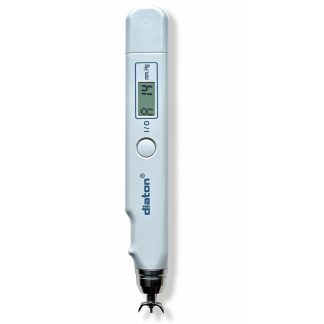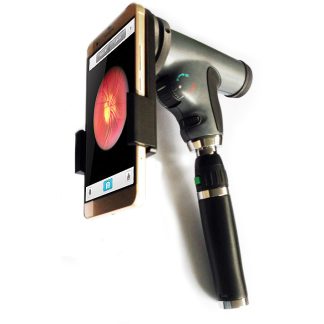
You have a patient in the chair whose cornea won’t cooperate — a graft, a scar, heavy edema, or a kid who won’t hold still at the slit lamp — and your Goldmann reading is a guess. That’s the exact gap the Diaton tonometer fills. It measures intraocular pressure through the eyelid, so the cornea stops being the problem. Here’s when that actually matters and when it doesn’t.
What “transpalpebral” actually buys you
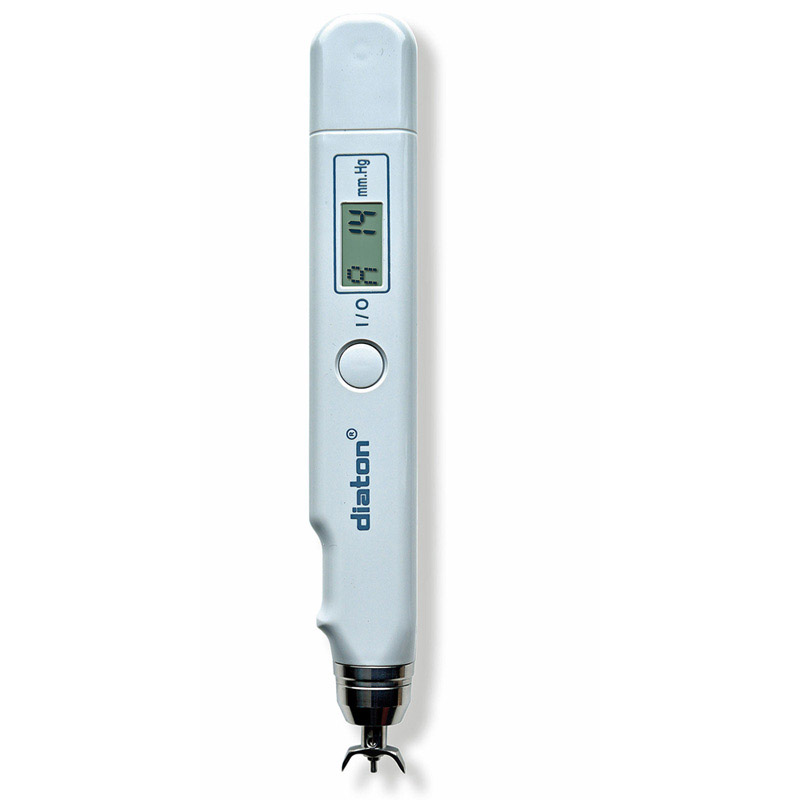 The Diaton takes IOP through the upper eyelid over the sclera. Nothing touches the cornea. That single fact removes three things you normally have to manage: topical anesthetic, corneal contact as an infection route, and — most importantly — the corneal variables that distort applanation. Central corneal thickness, curvature, scarring, and prior refractive surgery don’t feed into a transpalpebral reading the way they do with Goldmann or an air puff.
It’s also fast and position-independent. No slit lamp, no drops, no fixation on a target. The patient can be upright, supine, or in a wheelchair, which is why it shows up in bedside and screening settings as often as in the lane.
The corneas where applanation lets you down
This is the core use case. If a cornea is edematous, scarred, irregular, or carrying a keratoprosthesis, applanation numbers get unreliable — and that’s precisely the eye where you can’t afford to miss a pressure spike. Post-LASIK and post-PRK patients are the everyday version of this: thinner, reshaped corneas make Goldmann read artificially low, and a transpalpebral reading sidesteps that error entirely.
Once you’ve cleared the cornea problem, the second place the Diaton earns its keep is patients you simply can’t get to the slit lamp.
Pediatric and uncooperative patients
 Kids are the clearest win. No drops and no corneal contact means far less of the flinching and guarding that wreck an applanation attempt, and the literature suggests a large majority of pediatric patients tolerate the transpalpebral approach better than Goldmann. The same logic covers adults with tremor, dementia, or anxiety who can’t hold a stable position — and any situation where you need a quick pressure check without setting up the whole lane.
Be honest about the limits
The Diaton is a complement, not a wholesale replacement for Goldmann applanation, which is still the reference standard for routine glaucoma management. Transpalpebral readings carry more variability, and technique matters — lid thickness and probe placement affect the number, so it rewards a clinician who has done a few dozen. Use it where applanation is compromised or impractical, and keep applanation for the stable, normal corneas it was built for. If you want a middle option for irregular corneas that still touches the sclera-adjacent surface, a handheld like the Tono-Pen XL is worth having in the same drawer.
What to check before you buy one
Confirm the unit powers on and holds calibration, that the case and any tip components are complete, and ask what was verified before it shipped. A used or refurbished tonometer is only as good as the inspection behind it.
Currently in stock at Digital Eye Center: the Diaton tonometer for through-the-lid IOP, plus handheld options including the Tono-Pen XL and Tono-Pen XL Reichert, and the Topcon CT-80 non-contact tonometer for standard non-contact screening. Every unit is condition-graded before it leaves the bench.
Every used and refurbished tonometer we sell is inspected and function-tested by a technician before it leaves Florida, and it ships with a warranty.
Tell us the eyes you’re struggling to measure — post-graft, post-refractive, pediatric, or bedside — and we’ll tell you whether the Diaton is the right tool or whether a handheld fits better. Call 305-771-4562 or contact us here, or browse our full tonometer inventory.