You already measure IOP on every patient. The question is which tonometer fits how your practice actually runs — not which one looks best in a spec sheet. If you’re deciding between a Tono-Pen and a non-contact tonometer (NCT), the answer depends on your patient mix, your workflow, and one or two clinical realities that most buying guides gloss over.
What Each Instrument Actually Does
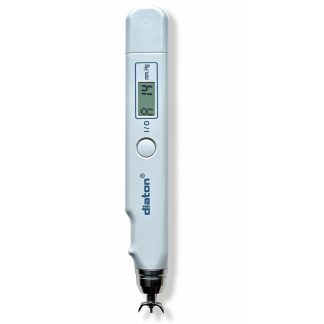
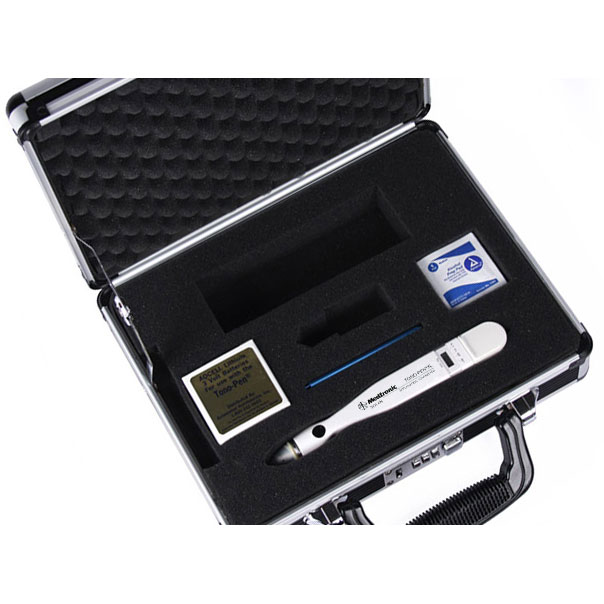 The Tono-Pen is a handheld contact tonometer. A disposable latex sheath goes over the tip, the patient gets a drop of topical anesthetic, and the device records several IOP readings across the corneal surface and averages them. It’s roughly the size of a thick pen and works from any angle — the patient doesn’t need to sit at a slit lamp.
The non-contact tonometer uses a brief puff of air to flatten the cornea and calculates IOP from the applanation response, no anesthetic required. Most modern NCTs — like the Topcon CT-80 or the Reichert 7cr — are table-mounted, fast, and can be operated by a tech rather than a clinician.
The Clinical Trade-Offs
Corneal irregularities. On a post-LASIK cornea, a keratoconus patient, or a corneal transplant, the NCT’s air-puff method introduces more measurement error. The Tono-Pen contacts a small central area and averages multiple readings — giving you better consistency on atypical corneas. If corneal surgery or ectasia is common in your practice, the Tono-Pen is the better clinical tool.
High IOP readings. NCT accuracy degrades above roughly 30 mmHg. For screening and monitoring most patients, this doesn’t matter. For patients with suspected acute angle closure or very elevated IOP, you want contact applanation — Goldmann, or a Tono-Pen as the next-best option.
Patient positioning. The Tono-Pen is the standard for patients who can’t comfortably use the slit lamp — pediatric patients, wheelchair users, post-op patients in recovery. Some practices keep an NCT for the flow of routine exams and a Tono-Pen for the patients who can’t sit at the instrument. That combination covers everything.
Workflow and Volume
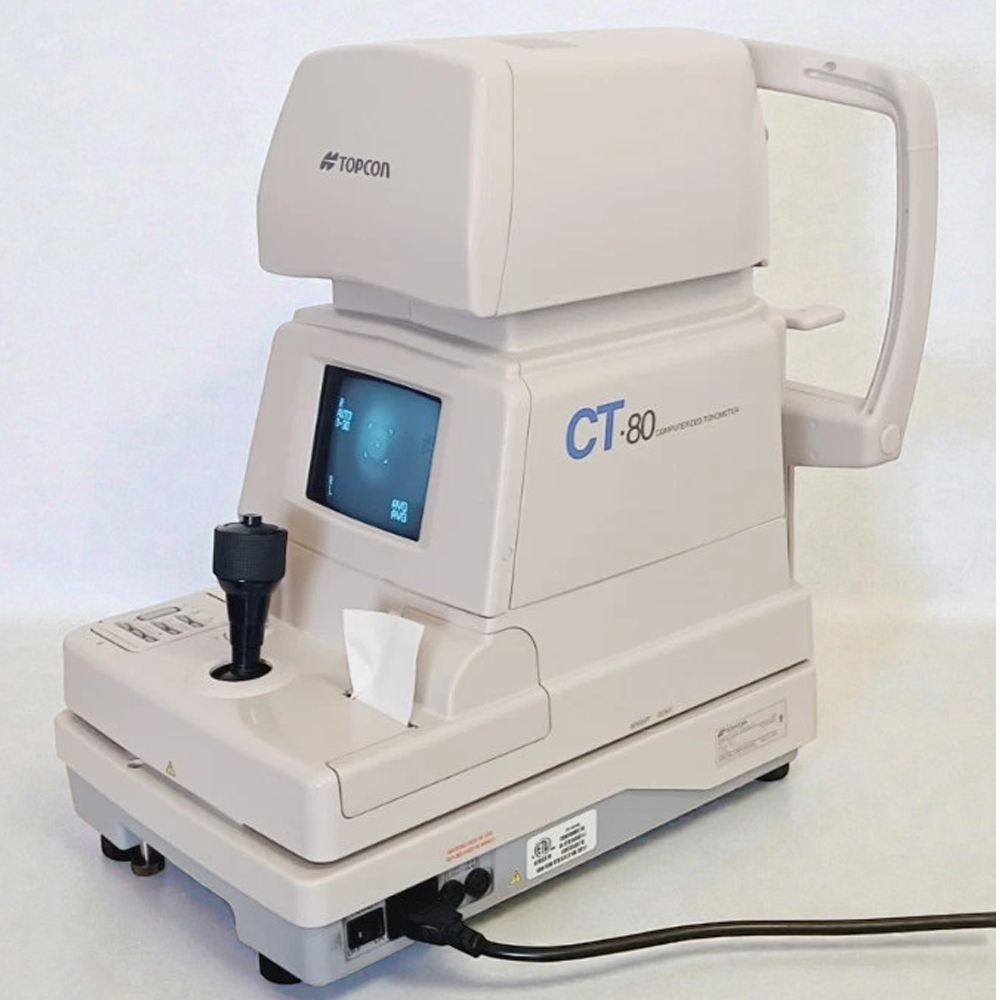 This is where the NCT typically wins. At 30 or 40 patients a day, having a tech run IOP in the pretesting lane — no anesthetic, no prep, no disposables — saves real time. The Topcon CT-80 is one of the most reliable used NCTs on the market for this reason: it’s fast, lane-mounted, and requires minimal training to operate consistently.
The Tono-Pen requires anesthetic, disposable sheaths, and clinician time. At high volume, that adds up. If your practice sees fewer than 20 patients a day, or if your population skews toward complex corneas or post-surgical eyes, the additional clinical precision justifies the extra steps.
What Practices in Florida Are Actually Buying
Based on what we see come through Digital Eye Center, solo ODs and small group practices tend to buy one of each — a table-mounted NCT for routine flow and a refurbished Tono-Pen for the edge cases. Ophthalmology practices with a cornea or glaucoma subspecialty skew harder toward contact methods.
If you’re equipping a new lane or replacing aging equipment, the refurbished market for both instrument types is healthy. A used Reichert 7cr Auto Tonometer runs around $3,850. A refurbished TonoPen XL Medtronic is around $2,695 — roughly the cost of one month of sheaths for a high-volume practice.
Currently in stock at Digital Eye Center:
— TonoPen XL Medtronic Refurbished
— TonoPen XL Reichert Refurbished
— Topcon CT-80 Non-Contact Tonometer Used
— Reichert 7cr Auto Tonometer Used
Or browse our full tonometer inventory.
Every tonometer we sell has been inspected and tested by a certified ophthalmic technician before shipping. Refurbished units include a 6-month warranty; used units include a 90-day warranty. All ship from Florida within 2–3 business days.
Call us at 305-771-4562 and tell us what you’re measuring and on what patient population — we’ll point you to the right instrument. Or contact us here if you’d prefer email.