You’re looking at two OCT listings — one says “used,” one says “refurbished” — and the price difference is significant. Before you buy a used OCT machine, you need to know what those labels actually mean in the ophthalmic equipment market. They’re not standardized terms, and vendors use them differently.
What “Used” Actually Means
 A used OCT machine is exactly that — a unit that was previously owned and is being resold, typically with minimal intervention between the prior owner and you. It might have been cleaned. It might have been tested to confirm it powers on. In most cases, that’s the extent of the vetting.
That’s not a red flag by itself — plenty of used OCTs are perfectly functional, especially units from reliable platforms like the Zeiss Cirrus 500 or Heidelberg Spectralis that were well-maintained in a low-volume clinic. But when you’re buying used, you’re largely relying on the prior owner’s maintenance history. Ask for it. If the seller can’t provide service records, price it accordingly.
What “Refurbished” Should Mean — and What to Verify
The American Academy of Ophthalmology considers OCT standard of care for diagnosing and monitoring retinal and glaucomatous disease — which means a used OCT machine that meets your clinical needs is a smart investment, not a compromise. Refurbished implies a documented process: inspection, component replacement where needed, optical alignment verification, and functional testing before resale. The key word is “documented.” Anyone can put “refurbished” in a listing title. The question is what was actually done.
Before buying a refurbished OCT, ask:
- What specifically was inspected and what was replaced?
- Was optical alignment tested after reassembly?
- What firmware version is it running, and is it compatible with your EMR?
- Who performed the refurbishment — an in-house technician or a certified service center?
- What warranty is included, and what does it cover?
If the seller can’t answer those questions, “refurbished” is just a label. The price premium isn’t justified without documentation.
The Specs That Actually Matter
 Once you’ve cleared the condition question, focus on these.
Axial resolution: 5–6 micron is standard for posterior segment imaging on modern units. Older platforms with 10 micron resolution are fine for routine anterior segment work but may miss subtle RNFL changes you’re tracking over time.
Scan speed: A unit running at 27,000 A-scans per second is noticeably slower than one at 68,000. If you’re imaging patients with poor fixation — elderly, low vision, pediatric — scan speed matters more than you might expect. Motion artifact on a slow unit means repeat scans and longer chair time.
Software version: The hardware is the easy part. The harder question is whether the software is still supported. Some older Zeiss Cirrus and Topcon 3D OCT versions are at end-of-life for updates. If you need to export in a specific format or integrate with a newer EMR, confirm software compatibility before you buy.
Scan patterns available: If you’re doing glaucoma monitoring, you need the HD 200×200 cube or equivalent. If you’re following diabetic macular edema, you need the fast macular cube. Make sure the unit you’re buying has the scan protocols you actually use.
Who Each Option Fits
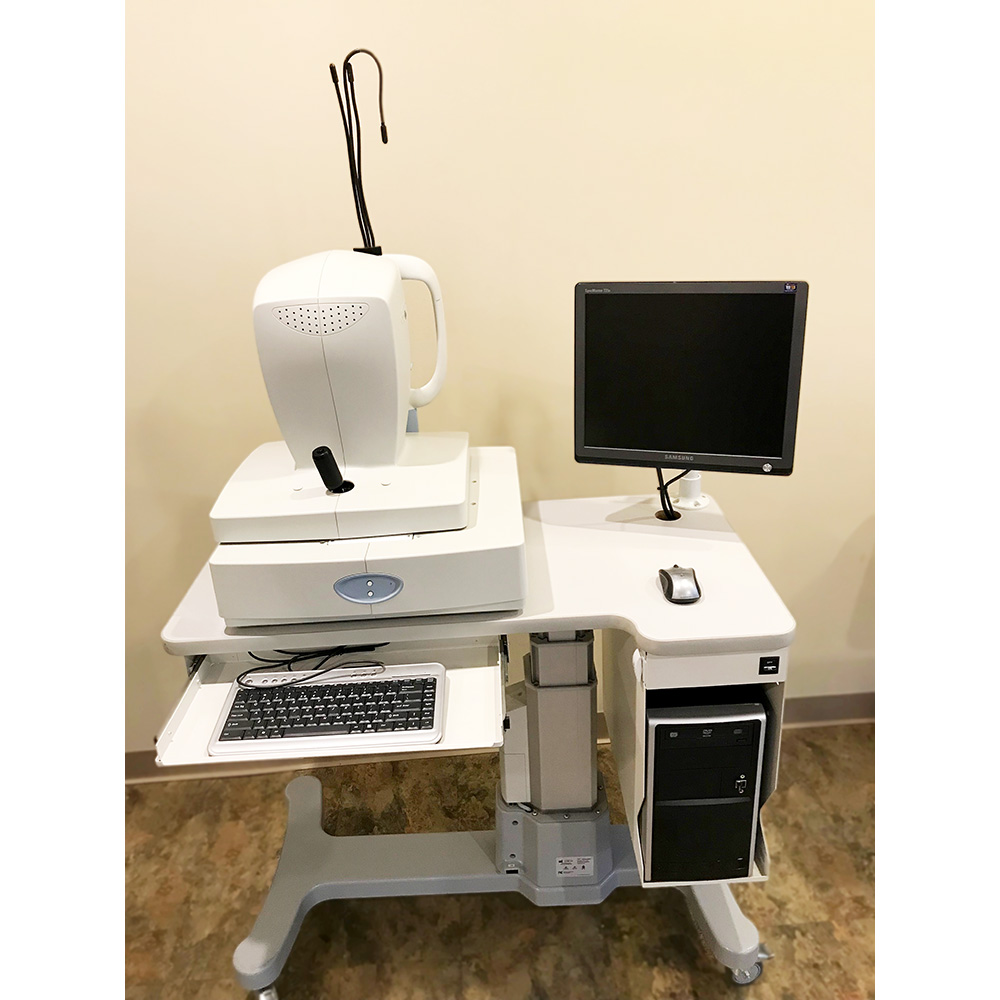 A solo retina specialist adding a second lane for overflow imaging can often do well with a well-maintained used Cirrus 400 or Cirrus 500 — the platform is proven, parts are available, and the image quality is sufficient for most follow-up documentation. Budget accordingly and build in a service margin.
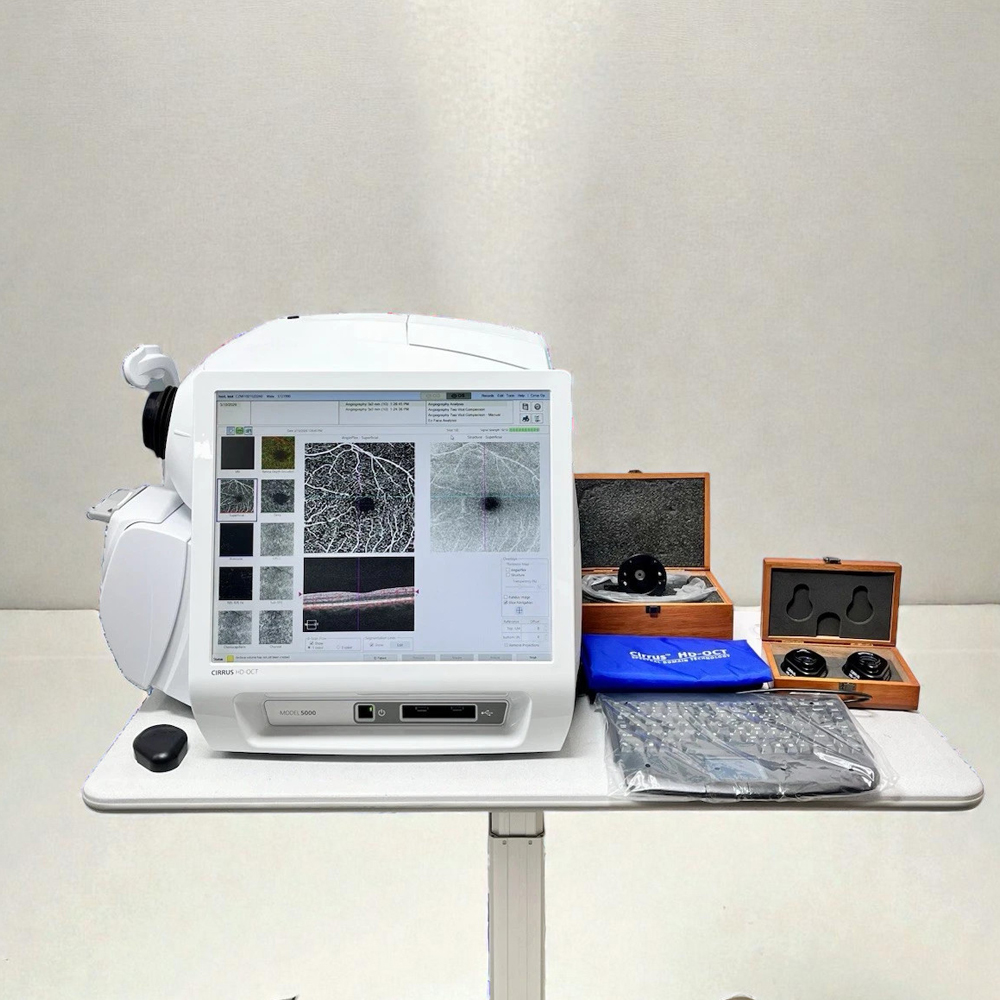
A glaucoma subspecialty practice that relies on OCT for longitudinal RNFL trending needs more certainty. Here, a used OCT machine like our Zeiss Cirrus 5000 (refurbished) with documented calibration and a warranty makes sense — you’re not just taking a one-time image, you’re building a baseline you’ll compare against for years. Drift in optical alignment between exams corrupts that data.
A mobile screening program, school district health clinic, or international buyer doing population screening doesn’t always need the latest platform. A unit like the Optovue RTVue-100 (refurbished) or a lower-tier Cirrus at a reduced price point may be exactly right — especially if cost per unit matters more than the latest scan protocols.
What to Do Before You Commit
When evaluating any used OCT machine, request the service history. Ask for a video of the unit powering on, loading a patient record, and completing a sample scan. If the seller is local or you have leverage, request an in-person inspection or a trial period. For international purchases, confirm whether a certified technician in your region can service the unit if something goes wrong — import-only platforms with no local support are a liability.
Browse our OCT inventory — currently including the Cirrus 5000 (refurbished), Cirrus 4000 (used), Cirrus 500 (refurbished), and Optovue RTVue-100. Each listing specifies condition, includes photos, and reflects the unit’s actual state.
Every used OCT machine we sell has been inspected by a certified ophthalmic equipment technician before it ships, and each unit comes with a warranty. We don’t list units we wouldn’t put in our own practice.
Contact us — tell us your imaging volume, the conditions you’re tracking, and your budget, and we’ll point you to the right unit.