You’re deciding whether an auto lensmeter is worth it for a small practice, or whether the manual unit on your bench is still good enough. The honest answer depends on your volume, your lens mix, and how much operator variability you’re willing to live with. Here’s how to think it through before you spend on a unit you’ll use every single day.
Auto vs. manual: where the difference actually shows up
 Inside the range where 95% of your prescriptions live — roughly -6.00 to +5.00 D — a well-maintained manual lensmeter holds its own on raw accuracy. Where an automated unit pulls ahead is precision and repeatability: it removes the operator from the reading, so two techs get the same number, and it’s roughly three times more consistent unit-to-unit than a manual instrument.
If you’re verifying a handful of jobs a week, that gap may not justify the spend. If you’re checking incoming lab work, confirming warranty remakes, and neutralizing patients’ current glasses all day, the time saved and the arguments avoided pay for the unit quickly. That’s the real dividing line, not the spec sheet.
The specs that separate useful units from frustrating ones
Progressive handling. This is the one that matters most now. A modern auto lensmeter should identify a progressive lens automatically and track its corridor without you hunting for the marks. If most of what walks in is PALs, a unit that fights you on progressives will slow you down more than a manual one ever did.
 UV and blue-light measurement. Increasingly expected if you dispense premium coatings and want to document what the patient actually received. PD and prism reading. Useful for dispensing checks and remake disputes. Built-in printer. Small thing, big workflow win — a printed record attached to the job tray settles most “the lab got it wrong” conversations before they start.
Don’t overbuy. A solo lane that dispenses mostly single-vision doesn’t need every measurement mode; a busy optical that lives on progressives and premium coatings does.
Buying refurbished: what to confirm first
Auto lensmeters are mechanically simple and age well, which makes the used market genuinely attractive. Before you buy a refurbished unit, confirm a few things: that it was tested and calibrated against a known standard, what condition the display and keypad are in, whether the printer works and takes paper you can still source, and what warranty is included. A unit that was cleaned up cosmetically but never verified against a reference lens is not refurbished — it’s just used with better photos.
Ask what specifically was inspected, whether readings were confirmed across the plus and minus range, and whether progressive detection was tested. Those answers tell you more than the price does.
Matching the unit to your lane
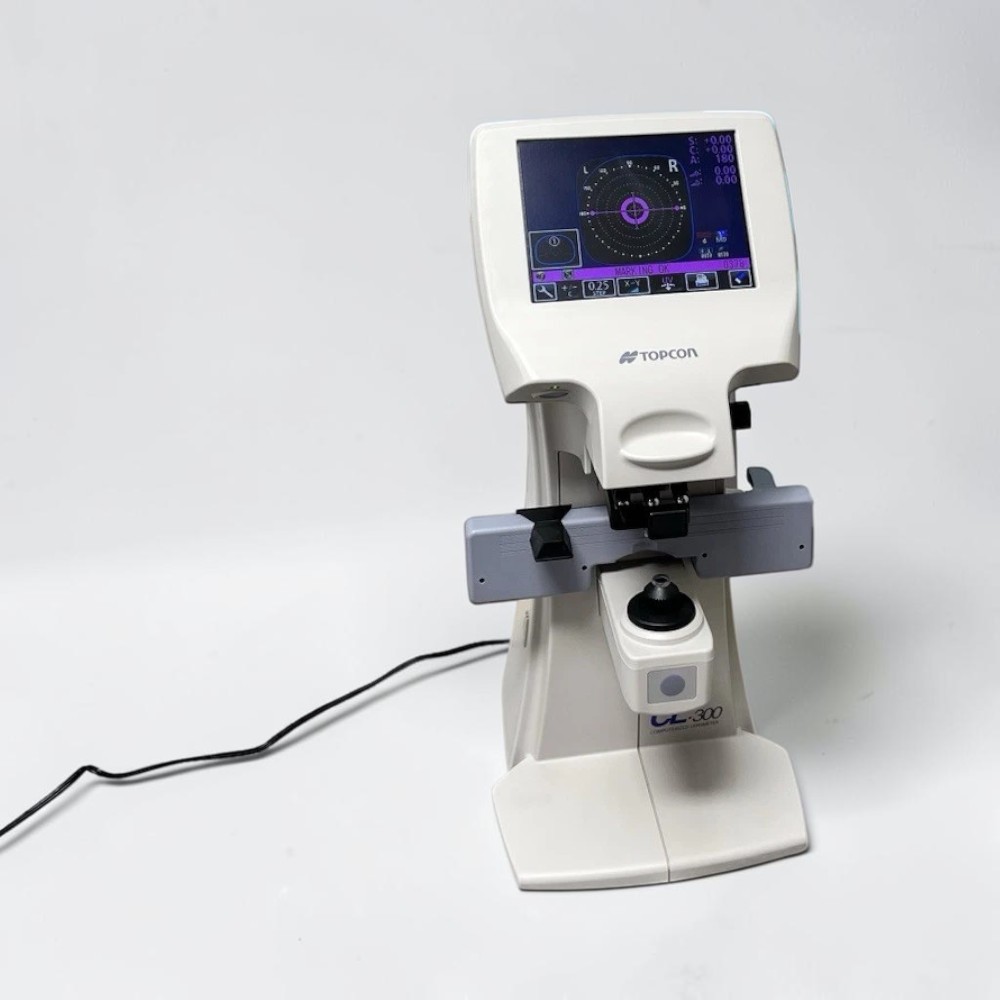
A single-doctor practice verifying its own jobs will be well served by a straightforward auto unit like the Reichert AL-700 Auto Lensometer or the Tomey TL-2000C Auto Lensometer. A higher-volume optical that wants printed records and faster progressive handling should look at a computerized unit such as the Topcon CL-300 Computerized Lensmeter. The best setup for most offices is still both an automated and a manual unit on the bench — the auto for speed and consistency, the manual as a reliable backup.
Currently in stock: Reichert AL-700 Auto Lensometer, Topcon CL-100 Auto Lensmeter with Built-in Printer, and the Topcon CL-300 Computerized Lensmeter. You can also browse our full lensmeter inventory.
Every refurbished lensmeter we ship has been tested and verified by a certified technician before it leaves Florida, and each one comes with a warranty. Orders ship within 2–3 business days.
Call us at 305-771-4562 and tell us your lens mix and how many jobs you verify a day — we’ll point you to the auto lensmeter that fits, not the most expensive one on the shelf. Or contact us here.